Forklift use in the UK is governed by health and safety law rather than a single “forklift act”, and the main duties sit with the employer. The rules that matter most are the Health and Safety at Work etc. Act 1974, PUWER 1998 and LOLER 1998, and they cover operator training, maintenance, thorough examination and keeping people on foot away from moving trucks. The laws themselves have been stable for years, but the accredited training categories that sit underneath them changed in January 2026, so it is worth checking if your operators are certified against the current framework.
Staying compliant protects your people first and your business second, because forklift accidents are still among the most serious in any warehouse or yard. At TAG Forklift Trucks we supply, hire, service and train across the North West, so we see every side of compliance day to day. This guide explains the laws that apply, what recently changed, and the practical steps that keep you on the right side of the Health and Safety Executive.
What laws govern forklift use in the UK?
There is no standalone piece of forklift legislation. Instead, several regulations overlap, and together they set out what an employer must do. The table below is the quick version, with the detail underneath.
| Regulation | What it covers |
| Health and Safety at Work etc. Act 1974 | The overarching duty to protect employees and others so far as is reasonably practicable |
| PUWER 1998 | Safe provision and use of work equipment, including operator training and daily checks |
| LOLER 1998 | Lifting equipment, safe lifting operations and thorough examination |
| Workplace (Health, Safety and Welfare) Regulations 1992 | Traffic routes, the separation of vehicles and pedestrians, and lighting |
| Management of Health and Safety at Work Regulations 1999 | Risk assessment and putting safe systems of work in place |
The Provision and Use of Work Equipment Regulations (PUWER) and the Lifting Operations and Lifting Equipment Regulations (LOLER) are the two that forklift operators meet most often. PUWER covers the truck as a piece of work equipment, and LOLER covers it as a lifting machine. A forklift sits under both.
What has changed for forklift training in 2026?
The underlying law has not changed, but the accredited training framework has. From 19 January 2026 the accrediting bodies that oversee operator testing, including AITT and others under the Accrediting Bodies Association for Workplace Transport (ABA), introduced a revised set of training categories. The aim is to match each machine type to a clearer category so that a certificate reflects what someone has actually been trained to operate.
The main changes are worth knowing if you are booking training or auditing records:
- Reach and straddle trucks, previously split into D1 and D2, are now combined into a single D1 category.
- The redundant H3 tow tractor category has been removed, while H1 and H2 remain.
- A new SP1 category covers rider-operated vertical stock pickers.
- Low level order pickers move from A2 into a new E0 category.
- A new M4 designation covers pedestrian-operated stacker trucks.
None of this invalidates a competent operator overnight, but it does mean you should check that new certificates are issued against the current categories and that each operator is trained for the specific truck they use. Training on a counterbalance truck does not automatically cover a reach truck, and it never has.
Do you need a licence to operate a forklift?
There is no official forklift “licence” in the way there is for a car. The law requires employers to ensure operators receive adequate training and are competent to use the equipment safely. Training can be provided by an accredited organisation or a suitably competent in-house trainer, and certificates are useful evidence of completed training rather than a legal licence. The HSE’s approved code of practice sets out three stages: basic training, job-specific training and familiarisation on the equipment and conditions in which the operator will work.
Refresher training is good practice rather than a strict legal interval, and the HSE suggests reviewing an operator’s performance and retraining roughly every three to five years, or sooner if there is an accident, a near miss, a change of equipment or a change in the work. If you are bringing new starters up to speed, our forklift operator training covers the main truck types, including counterbalance and reach truck categories.
How often must a forklift be thoroughly examined?
Under LOLER, a forklift’s lifting equipment must normally undergo a thorough examination by a competent person at least every 12 months, or every six months if it is used to lift people. Different intervals may apply where a competent person has established a written examination scheme. A thorough examination is separate from routine servicing and checks the safety-critical lifting components, including the forks, mast, chains and lifting mechanisms.
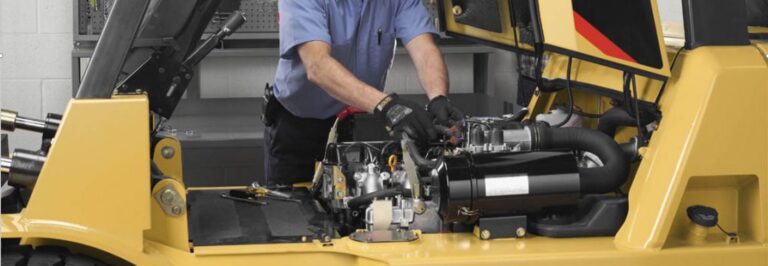
PUWER then adds the day-to-day layer. Operators should carry out pre-use checks at the start of each shift, covering the obvious things like tyres, forks, hydraulics, brakes, lights and the horn. Routine servicing and maintenance keeps the truck reliable between examinations and gives you the paper trail that proves the machine was looked after. Many operators schedule service visits around the manufacturer’s hour intervals, often every 250 hours or six months, whichever comes first.
What are the rules for forklifts and pedestrians?
Keeping people on foot away from moving trucks is one of the biggest safety duties you have, and the HSE is clear that physical separation is the best approach. Where full separation is not possible, a combination of the following measures helps keep pedestrians safe:
- Separate walkways and vehicle routes, using barriers and giving pedestrians their own doors where possible
- Designated crossing points where walkways and traffic routes have to meet
- Good visibility, with mirrors and clear sightlines at junctions and blind corners
- Clear signage and floor markings to show who goes where
- Consistent lighting across the site, including yards and loading areas
- Speed control in shared areas, supported by speed limits and calming measures
- Blue safety lights, proximity warning systems and reversing alarms to give extra warning
These measures work best alongside a well-planned layout rather than in place of it.
Are there different rules for electric and specialist forklifts?
The core duties apply to every truck, but some types carry extra considerations. Electric forklifts bring battery charging and storage into scope, so charging areas need ventilation, the right electrical safety measures and a sensible approach to handling batteries. Rough terrain machines and telehandlers face stricter stability checks because of the ground and loads they handle. The common thread is that operators must be trained on the specific machine and category, not just on forklifts in general.
Can you drive a forklift on a public road?
Most forklift work happens on private sites, but if a truck needs to travel on or cross a public road it has to meet road legal requirements. That generally means registration with the DVLA, road tax, valid insurance, and lights, indicators and mirrors fitted to the machine. The operator also needs the appropriate driving entitlement. If any of your work involves the public highway, treat it as a separate compliance question and check the current DVLA guidance before you send a truck out.
How can you keep your forklift operation compliant?
Compliance is easier to keep than to recover once it slips. A few habits cover most of it:
- Keep risk assessments and traffic management plans current, and review them after any change or incident.
- Hold a training log that shows each operator’s categories, dates and refresher status.
- Book LOLER thorough examinations on time, every 12 months, or every six months for people-lifting.
- Run daily pre-use checks and record them, however briefly.
- Keep service records, examination reports and defect logs together so you can produce them on request.
A fleet management system can pull a lot of this together automatically, logging checks, flagging service dates and keeping operator records in one place, which is a genuine help once you are running more than a handful of trucks.
Keep your fleet compliant with TAG
Compliance runs through everything we do, from the trucks we supply to the training we deliver and the servicing that keeps machines safe between examinations. If you are reviewing your setup, we can help you match the right equipment to the job and keep the paperwork straight. We also hire out fully maintained forklifts and supply new and used trucks across the North West.
Call the team on 0161 848 0555 or get in touch to talk through your training, servicing or equipment needs, and we will reply the same working day.
Hire, buy or service with TAG
Independent forklift hire, sales and servicing across Manchester and the North West since 1994.